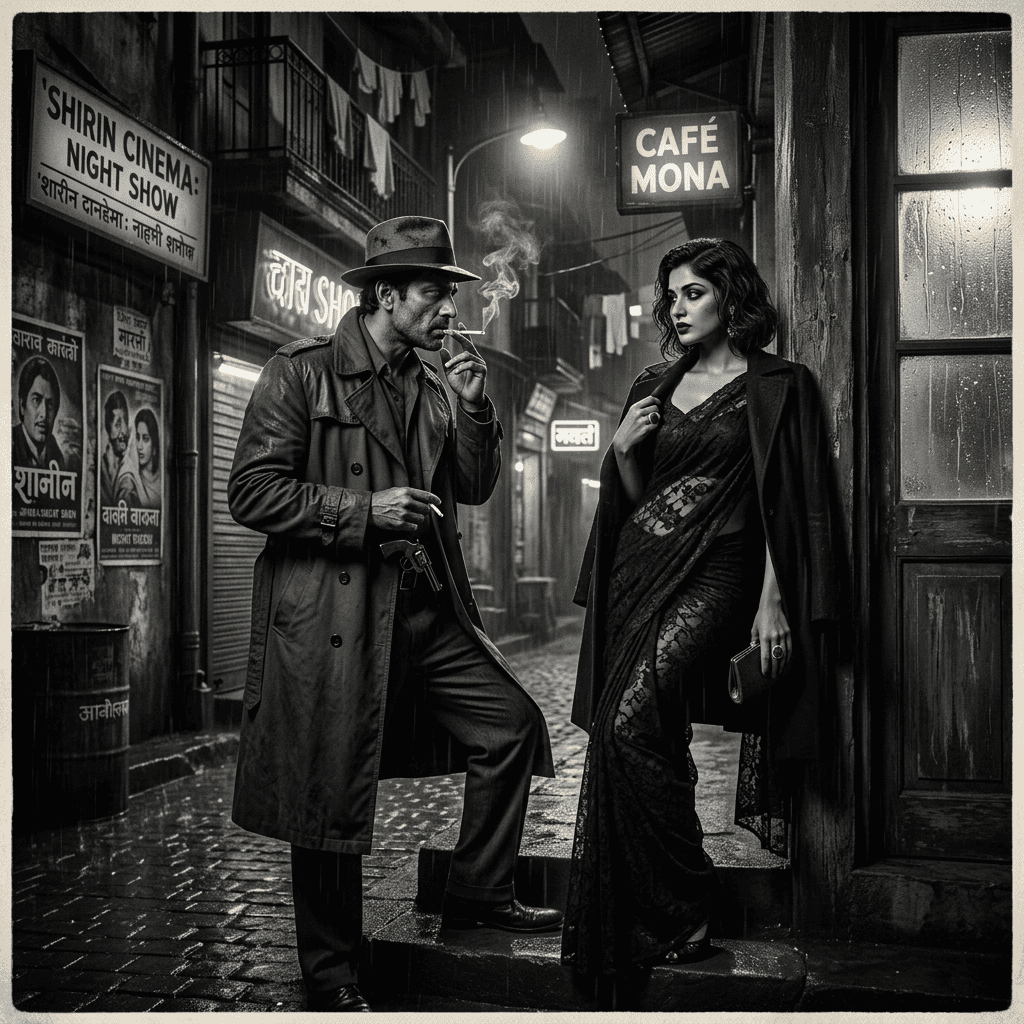
Guru Dutt directed the Dev Anand starrer Baazi in 1951. And a new genre of Hindi movies was born – Bombay Noir.
Almost all of the Bombay Noir movies of the fifties featured Dev Anand, Guru Dutt, or both.
From Baazi to Jaal to CID, their collaboration produced some unforgettable gems. Separately each of them also had some great movies in this genre. Dev Anand featured in Taxi Driver, House No 44 and Kala Bazar. Guru Dutt featured in Aar Paar and 12 O’Clock.
I confess that I am a huge fan of this genre. I am also a big fan of both Guru Dutt and Dev Anand. This is one reason why my playlists contain so many songs from Bombay Noir movies.
The Birth of Bombay Noir
A chance meeting on the sets of “Hum Ek Hain” led to a life-long friendship between Dev Anand and Guru Dutt. Back then they were both struggling newcomers – one in his debut movie as a hero, and the other an assistant dance director. Both had ambitions beyond that. Dev wanted to be a producer, and Guru Dutt wanted to be a director. A pact was made between the two friends – Guru Dutt would make Dev Anand the hero of his first movie, and Dev would make Guru Dutt the director for the movie he would produce.
Four years later, the opportunity came when Dev Anand’s Navketan Films was starting on their second venture. Dev fulfilled his promise to Guru Dutt by making him the director of Baazi. The rest as they say is history.
The Making of Baazi
Guru Dutt was enamored with Film Noir, and here was an opportunity to create a Noir film in Hindi.
The country had just become independent. CIties like Mumbai (Bombay back then) were fast becoming the destination for people coming to fulfill their dreams. They were also places where poverty was stark, crime was rampant and people often lost their way.
This was fertile ground for a noir movie, and Baazi was the perfect movie. An honest young man who had seen better days gets drawn into a world of gambling and crime. He eventually gets framed for a murder he did not commit. What can be more noir than that?
Guru Dutt shaped Baazi into a noir movie that could stand proud in the company of cult classics like Gilda, The Maltese Falcon and Double Indemnity. It checked all the boxes to qualify as a noir film – a flawed hero, a femme fatale, cabaret sequences in a smoky club, urban setting, low-key lighting and more.
It is interesting to me that two of the highest grossing movies of 1951 were Awaara and Baazi – both movies about antiheroes. Dilip Kumar followed suit a couple of years later with Footpath.
Film Noir
Wikipedia defines Film Noir as “encompassing a range of plots, commonly featuring mysteries/crime dramas, detective fiction, and stories with themes of corruption, organized crime, redemption, cynicism, and tragedy.”
There is much debate about precisely what makes a movie a “noir” movie. After all, the term itself was coined by a French critic to describe a lose collection of American crime thrillers of the ’40s. Although these films were generally speaking “detective stories”, they varied widely in terms of the plots.
In the words of Nino Frank, “rejection of sentimental humanism, the social fantastic, and the dynamism of violent death” is the unifying thread that ties movies like “The Maltese Falcon”, “Laura”, “Double Indemnity”, He called this “Film Noir”.
Bombay Noir
The Hollywood Genre of Film Noir was the inspiration behind Bombay Noir. These Noir movies borrowed aspects of these plot elements as well as the stylistic elements like low-key lighting, club settings, etc. But they added their own desi tadka with romance, comedy, and above all, some wonderful songs.
In terms of substance, they toned down the cynical pessimistic core of film noir a bit. They made the morally ambiguous protagonists to be victims of circumstances reluctantly entering into a world of crime. For the most part, these movies had relatively conventional Hindi movie endings, with the hero and heroine living happily ever after.
Rajeev Shrivastava Describes Guru Dutt’s depiction of Bombay in Aar Paar this way –
“Here was Bombay as more than a backdrop; it was a living, breathing character — part temptress, part predator. And in the middle of it all was “Babuji Dhire Chalna,” a song that distilled the genre’s allure into four minutes of music and movement. It was glamour with a knife behind its back, desire laced with danger — an intoxicating blend that left audiences seeing the city, and cinema, in a whole new light.”
Key Features of Bombay Noir Films
If you see some or all of these characteristics in a Hindi movie from the fifties and early sixties, it is likely that it is a Bombay Noir movie –
Much of the action takes place either in smoke filled clubs or on the dark streets of the city.
- A down-on-luck protagonist struggling to survive in the gritty underbelly of urban sprawl. (Baazi, Taxi Driver, Aar Par)
- The lines often blur between right and wrong. (Jaal, House No 44)
- A shadowy world of crime that the protogonist is drawn into. (Baazi, House No 44)
- Sometimes he is a cop or a detective fighting against that world of crime. (CID, 12 O’Clock)
- Stark black and white cinematography with chiaroscuro lighting and a dreamy ambience. (Baazi, House No 44, Taxi Driver)
- A mysterious uber villain who operates in the shadows. (Baazi, House No 44, Aar Paar)
- A “Femme Fatale” who is often the villain’s moll who ends up supporting the hero. (Baazi, Taxi Driver)
How They Deferred from Film Noir
Bombay Noir movies deferred from Film Noir in many ways –
- They did not completely reject sentiments and idealism
- Romance remained prominent in the plot
- Music was one of the key elements drawing audience
- They featured conventional endings, with boy winning the girl, and good triumphing over evil
Music in particular in those movies tended to be soulful and captivating. Composers like S D Burman and O P Nayyar gave some of their best score in these movies. Lyricists like Sahir, Majrooh and Jan Nisaar infused the songs with a dreamy magic. Singers like Rafi, Hemant Kumar, Geeta Dutt, Lata Mangeshkar and Asha Bhosle gave us songs we remember fondly to this day.
By the end of the fifties, there was a resurgence of sentimental “family dramas” – mostly remakes of movies from the South. Bombay Noir lost much of its edgy appeal. A few film makers continued making movies with some aspects of this genre, but they added the glitz and glamour that the audience of the sixties expected.
Much later, in the nineties and the new millennium, directors like Ram Gopal Verma and Anurag Kashyap made movies that came to be known as “neo noir” movies, like “Satya”, “The Last Train to Mahakali” etc.
My Favorite Bombay Noir Movies
As I mentioned above, there is much debate about what makes a movie noir. Plenty of movies made in the fifties and sixties had elements of this genre. Some like Gateway of India or Passport have the urban crime ambience and slick suspense, but they are not regarded as Bombay Noir as they do not have the key elements of night club ambience, shadowy crime lords and femme fatale characters.
Among the ones I have seen, these movies stand out as the best of the genre. I will briefly describe each of them and highlight the specific features that qualify them as Bombay Noir –
1. Baazi (1951)

Overview
Baazi was the movie that launched this genre. Madan (Dev Anand) is a drifter with a reputation as a gambler with a lucky hand. He has a sick sister to care for, which prompts him to accept the offer of employment by a shady crime lord to work for him at the Star Hotel. His job is to entice rich unsuspecting customers to gamble in the casino and lose their money. He is in love with Dr Rajani (Kalpana Kartik).
Dancer Leena (Geeta Bali) at the club takes a liking to him. One day she gets killed, and Madan is accused of her murder. Inspector Ramesh (Krishan Dhawan) arrests him. During the investigation it is revealed that Rajani’s father (K.N. Singh) is in fact the shady crime lord, who sent his henchmen to kill Madan. When Leena ends up getting killed while trying to save Madan, he frames Madan for her murder.
Ramesh establishes Madan’s innocence, and Madan and Rajani unite in a happy ending.
Some aspects of the plot were borrowed from the noir film “Gilda“.
Bombay Noir Elements in the Movie
- Morally ambiguous protagonist (Dev Anand) who gets drawn into a life of crime
- Shadowy crime lord with a nefarious network (K N Singh)
- Femme Fatale (Geeta Bali) who helps the hero
- Hotel/Nightclub locale with cabaret style entertainment (Star Hotel)
- Slick and fast-moving editing and stark black & white cinematography with chiaroscuro lighting
What I Liked in this Movie
I made it clear at the beginning that I love this movie. There are many reasons for that. Some of which I already mentioned – that I am a fan of Guru Dutt, Dev Anand and Bombay Noir. But there is more to Baazi than that.
Artists Who Made the Difference
Guru Dutt and Dev Anand were almost like the founding fathers of this genre. However, it is important to mention other contributors who were significant.
K N Singh established a new benchmark for villainy with this movie.
Johnny Walker made his debut in this movie. He went on to star in many of the Bombay Noir movies in the fifties.
Raj Khosla, who went on to direct several noir movies himself, began his career as an assistant director in this movie.
Also noteworthy were the contributions of IPTA veterans Balraj Sahni (story) and Zohra Sehgal (choreography). According to Yasser Usman, Dev Anand brought in heavyweights Balraj and Zohra to calm his brother Chetan’s apprehensions about entrusting their movie to a novice director.
Music and Lyrics
Sahir Ludhianvi, S D Burman and Geeta Dutt was an inspired team that made Bombay Noir history. Every song in this movie is an unforgettable gem. There are six songs by Geeta Dutt and one each by Shamshad Begum and Kishore Kumar. Four songs on Geeta Bali, three on Kalpana Kartik and one on Dev Anand. Interestingly, there are no duets in this movie.
Sahir’s lyrics are inspirational – “insaf tere saath hai, ilzaam uthale, apne pe bharosa hai to daao laga le, laga le daao laga le!”
His romantic songs are equally memorable – “yeh kaun aaya, ki main apni dhadkan sun ke sharmayee!” or “dil ki kahani, apni zubani, tumko sunane aayi hun, aankon mein leke sapne suhane, apna banane aayi hun!”
2. Jaal (1952)

Overview
Jaal was the second Guru Dutt/Dev Anand movie. Of all the Bombay Noir movies, this one was perhaps the darkest in terms of the theme. Unlike other movies of this genre, here the protagonist is an out-and-out unrepentant criminal, with no mitigating circumstances to justify his moral turpitude.
Tony (Dev Anand) is a narcissistic smuggler who ensnares (hence the title) gullible women with his charm. Maria (Geeta Bali) is an innocent Goan fisherwoman who falls in love with him, only to realize that he was only interested in her so she could be his courier in his smuggling operations.
As the police chase and close in on them, Tony is transformed by Maria’s belief in absolution, and surrenders to the police.
Maria is left waiting for Tony’s return from the prison.
The movie was inspired by “Riso Amaro” or “Bitter Rice”, an Italian noir film.
Bombay Noir Elements in the Movie
- Morally decrepit protagonist (Dev Anand) who ruthlessly uses people to get what he wants
- A nihilist plot that revolves around crime and chasing the criminals
- Femme Fatale (Purnima) who in this case helps the heroine, as the hero doubles up as the shadowy crime lord
- Smugglers trying to evade the police at the port while carrying contraband gold
- Low key lighting and black and white cinematography by V K Murthy
- For a change the main locale is a fishing village in Goa and not Bombay, although Bombay figures prominently as the destination of the smugglers
What I Liked in this Movie
Jaal was a daring movie to make in the fifties. Unlike Baazi, here the hero is not a reluctant criminal. He has no qualms about manipulating the heroine so that she can unwittingly act as a courier for his smuggling. Surprisingly however, the movie was a success and was the third highest grossing film of 1953.
Artists Who Made the Difference
Much of the star cast came from Baazi. For a change, K N Singh (Maria’s brother Carlo) and Rasheed Khan (Inspector Pedro) are the “good guys”. Geeta Bali gets promoted to the role of the heroine from being a femme fatale. Johnny Walker continues in the role of the hero’s associate in the criminal world.
Johnny Walker once again plays the role of the Hero’s friend and accomplice.
Cinematography by V K Murthy was particularly noteworthy. He continued working with Guru Dutt on all of his movies and established a name for excellent black and white photography.
Music and Lyrics
The music once again is the highlight for this movie. S D Burman and Sahir Ludhianvi created incredible songs that remain popular to this day.
Lata Mangeshkar and Hemant Kumar sang most of the songs. Kishore Kumar and Geeta Dutt featured in one song each.
“Pighala Hai Sona, Door Gagan Par” is a beautiful lyrical song picturized on Geeta Bali on a boat at dusk. The backdrop to the song is the beautiful Goan coastline.
Dev Anand serenades Geeta Bali with the mellow “Yeh Raat Yeh Chandni Phir Kahan” in the deep voice of Hemant Kumar.
Lata delivers a lively Goan folk song with “Chori Chori Meri Gali Aana Hai Bura”.
3. Taxi Driver (1954)

Overview
After Jaal, Dev Anand continued with the Bombay Noir genre with Taxi Driver. Chetan Anand wrote the story and directed the movie.
Mangal (Dev Anand) is a taxi driver in Bombay who frequents a local nightclub where Sylvie (Shiela Ramani) is a dancer. Sylvie likes Mangal but he does not reciprocate her feelings.
One day Mala (Kalpana Kartik), a village belle arrives in Bombay with dreams of becoming a singer in Movies. Mangal rescues her from local goons who were trying to molest her. Inevitably the two of them fall in love.
Meanwhile the goons who attacked Mala turn out to be members of a gang of bank robbers working for a mysterious “sethji”. One day they abduct Mangal and Mala and steal his taxi. They use the taxi as a getaway vehicle for one of their heists.
When Mangal reports to the police, the gangsters come after him and Mala. They attack them in the nightclub. Sylvia helps them in the fight and ends up getting killed in the process.
Mangal and Mala drive away in the taxi.
Bombay Noir Elements in the Movie
- Down-on-the luck loner (Dev Anand) who is struggling to make a living in the city of dreams
- Gang of bank robbers with a mysterious boss with connections to the movie industry
- Femme Fatale (Sheila Ramani) who helps the hero and ends up getting killed
- Urban poverty and crime as the backdrop of the story
- Low key lighting and black and white cinematography by V Ratra
- Smoky nightclub where much of the story including the climax takes place
What I Liked in this Movie
Taxi Driver significantly softens the edginess of Bombay Noir. The protagonist retains much of the conventional good qualities of a Hindi Movie hero. He sees a damsel in distress and valiantly fights with the goons and rescues her. Like a good Samaritan, he gives her shelter in his house and helps her find the person who promised to make her a singer. Sure, he visits nightclubs, drinks cheap liquor and gambles, but he has a heart of gold.
Artists Who Made the Difference
Gurudutt is replaced by Chetan Anand, who also wrote the screenplay. The story was written by his wife Uma and brother Vijay Anand.
Sheela Ramani as the Femme Fatale was a delight to watch. Johnny Walker is once again the hero’s friend.
Music and Lyrics
S D Burman and Sahir Ludhianvi repeat their magic once again. This time the singers included Talat Mehmood, Asha Bhosle and Jagmohan Bakshi. In addition to the hauntingly melodious tandem “Jaaye To Jaaye Kahan”, Asha and Jagmohan sang a delightful duet “Dekha Mane Nahin Roothi Haseena”.
The lines “Marna to sab ko hai, jeeke bhi dekh le, chahat ka ek jaam peeke bhi dekh le” is vintage Sahir.
4. House No 44 (1955)

Overview
House No 44 was the third noir movie under the Navketan banner.
Ashok (Dev Anand) is a small-time crook working for Sunder (Bhagwan Sinha). Sunder is part of a criminal gang led by the mysterious “Captain” (K N Singh who returns to being the shadowy crime lord).
Sunder gives shelter to Nimmo (Kalpana Kartik) and in return makes her do odd jobs for him. She is unaware that the jobs she is asked to do are criminal in nature.
Ashok tries to shield her from crime. He gets into a fight with Sunder and leaves the gang while defending Nimmo.
Captain and his henchmen relentlessly pursue Ashok to bring him back to the fold.
When their efforts fail, they confront him in a dilapidated building with knives out for him. The police arrive and a shootout ends up killing Captain.
Bombay Noir Elements in the Movie
- A smalltime crook (Dev Anand) who joins a criminal gang
- A shadowy crimelord (K N Singh) who orchestrates a series of robberies
- Femme Fatale (Shiela Vaz) who helps the hero during a jewelry heist
- Urban poverty and crime as the backdrop of the story
- Low key lighting and black and white cinematography by V Ratra
- Night club where a jewelry heist takes place
What I Liked in this Movie
House No 44 brings back the “good guy falling into bad company” trope. As an orphan who grew up on the street, he has no qualms about joining a gang to make a living. But he draws the line at exploiting innocent women and making them unwitting accomplices. He is willing to take on the world to defend her.
Artists Who Made the Difference
Kumkum plays a small but crucial role as the dancer in a Kotha who hides the hero when the gang comes looking for him.
Chetan Anand brought in M K Burman to direct this movie.
Johnny Walker is missing in this movie.
Music and Lyrics
This is the fourth movie in this list where S D Burman and Sahir Ludhianvi joined forces to create timeless music. Hemant Kumar is once again the voice of Dev Anand. He sang two lovely songs – “Jaaye To Jaaye Kahan” and “Chup Hai Dharti, Chup Hai Chand Sitare”. Lata sang “Faili Hui Hain, Sapnon Ke Baahein” and “Peeche Peeche Aakar”. Asha sang “Dekh Idhar O Jaadugar” and “Dum Hai Baaki To Kya Gham Hai”. Once again, Kishore Kumar sings a lighthearted song for Dev Anand – “Oonche Sur Mein Gaaye Ja”.
5. Aar Paar (1954)

Overview
Aar Paar was Guru Dutt’s own production under his banner. He was also the director. Dev Anand was the original choice for the hero’s role, but when his dates were not available, Guru Dutt decided to play the role himself.
Kalu Birju (Guru Dutt) is a short-tempered taxi driver who had a brief stint in prison, He comes out and looks for a job as a mechanic with Lalaji (Jagdish Sethi).
Lalaji’s daughter Nikki (Shyama) falls in love with Kalu. When her father finds out that he is an ex-con, he fires him from his job.
While in prison, he was asked by a fellow inmate to give a message to a mysterious character when he is released. Interestingly this person is also called “Captain” in this movie (Bir Sakhuja).
He gives the message to Captain who arranges for a taxi. The condition is that he must drive Captain’s team whenever they call for him.
It turns out that Captain’s team wanted to use the taxi as a convenient means to drive around the city and commit robberies without raising suspicion.
Captain’s moll (Shakila) begins to develop feelings for him.
One day he notices the gang picking up parcels thrown from a running train. Suspicious, he confronts Captain and refuses to work with him.
After some drama and a high-speed chase, the police mange to round up the criminals. Kalu and Nikki unite and as always, live happily ever after.
Bombay Noir Elements in the Movie
- A temperamental taxi driver (Guru Dutt) unwittingly assists a criminal gang in their crimes
- A shadowy crime lord (Bir Sakhuja) who orchestrates a series of robberies
- Femme Fatale (Shakila) who likes the hero and saves him from getting killed
- Much of the action takes place in a nightclub
- Low key lighting and black and white cinematography by V K Murthy
- Slick editing and orchestration of the heists, with the taxi playing a key role
What I Liked in this Movie
Aar Paar was in many ways a total noir movie. The hero’s attitude is cynical and unsentimental (“aar ya paar” is what he tells the heroine when she asks him if love is just a gamble for him). There is a song (“Mohabbat kar lo, jee bhar lo aji kis ne roka hai”) that highlights this attitude.
As I listed above, it checks every box for a noir movie. The use of the taxi as a decoy during the heists is a typical noir movie scene.
Artists Who Made the Difference
V K Murthy’s cinematography captures the charm of Bombay of the fifties in stark black and white shots highlighting the shadowy shenanigans of Captain’s gang.
Shakila’s character is interesting. She is infatuated with Kalu and initially helps him by convincing Captain not to kill him, but she sides with Captain in the end and even participates in the shootout. In that sense she is a true femme fatale.
Kumkum who played a small role in House No 44 makes a cameo appearance here as well, as the construction worker singing the song “Kabhi Aar Kabhi Paar Laga Teere-e-Nazar”.
Johnny Walker as the Parsi gangster Rustam shows his comic chops. He even has a song – “Are Na Na Na Na, Tauba Main Na Pyar Karoongi”. Jagdeep plays the role of Kalu’s sidekick.
Music and Lyrics
After S D Burman and Sahir Ludhianvi, O P Nayyar and Majrooh Sultanpuri were the most frequent combination in Bombay Noir movies. With O P Nayyar, Mohammed Rafi makes an entrance in this genre. His duet “Sun Sun Sun, Jaalima” with Geeta Dutt is a delightful song. Geeta Dutt sang four solos and three duets. “Babuji Dheere Chalna” picturized on the siren Shakila and “Ye Lo Main Haari Piya” picturized on Shyama became famous.
6. C.I.D. (1956)

Overview
This was the last Bombay Noir movie where Guru Dutt and Dev Anand worked together.
Shekhar (Dev Anand) is a CID inspector. He is investigating the killing of a newspaper editor who was on the verge of exposing the underworld links of an influential businessman.
He is in love with Rekha (Shakila), who is the daughter of his boss SP Mathur (K N Singh once again as a “good guy”).
Master (Johnny Walker) is a pickpocket and an eyewitness to the murder. During the investigation Master identifies the killer Sher Singh (Mehmood). Shekhar arrests Sher Singh and starts to investigate him.
Dharamdas (Bir Sakhuja) is the shadowy villain who masquerades as a rich businessman. He uses his moll Kamini (Waheeda Rehman in her debut role) to try and bribe Shekhar.
Dharamdas gets..Sher Singh killed and pins the blame on Shekhar. He is put on trial, but he escapes and continues to search for the real killer.
After many twists and turns, Shekhar takes the help of Kamini to outwit Dharamdas.
In a dramatic climax scene set in a hospital, Dharamdas is caught red handed trying to kill Kamini.
Shekhar is absolved of the murder, and he unites with Rekha.
Bombay Noir Elements in the Movie
- A hardened detective (Dev Anand) is accused of murder and has to prove his innocence
- A shadowy crime lord (Bir Sakhuja) who is willing to commit murders to conceal his identity
- Femme fatale (Waheeda Rehman) who helps the hero defeat the villains
- Fast paced action sequences and investigation in the shadowy crime locales of Bombay
- Low key lighting and black and white cinematography by V K Murthy
- Hero breaks the law with a jailbreak to prove his innocence
What I Liked in this Movie
Raj Khosla learned his craft under Guru Dutt, and it shows in this movie. CID is a perfect blend of suspense, action, romance, comedy and music.
Right from the outset, the murder of a newspaper editor in his office sets the tone for the movie.
Artists Who Made the Difference
C.I.D was the reunion of Guru Dutt and Dev Anand. Except, this time Guru Dutt was the producer and Raj Khosla, his assistant from Baazi was the director. Interestingly, Pramod Chakraborty who was the assistant director in this movie went on to make some great noir movies himself.
Waheeda Rehman made a brilliant debut as the femme fatale Kamini. She moves effortlessly from the menacing abductor of Master to the seductive siren who tries to bribe the hero to the sweet friend of the heroine.
The usual suspects K N Singh, Johnny Walker and Bir Sakhuja play prominent roles. Kumkum (as Master’s girlfriend) and Sheela Vaz (as the dancer in the song “Le Ke Pehla Pehla Pyar”) make cameo appearances as well.
V K Murthy’s once again creates some great noir ambience with stunning visuals of the Bombay city streets.
Music and Lyrics
O P Nayyar composed some of his best songs, and an incredible background score for CID. One of songs (“Jaat Kahan Hai Deewane”) was removed by the censors, but the tune survived as the background music when Dev Anand enters the villain’s den to meet with Waheeda Rehman. Geeta Dutt, Mohammed Rafi and Shamshad Begum sang some incredible songs that remain popular to this day.
Majrooh Sultanpuri wrote some playful lyrics for songs like “Boojh Mera Kya Naam Re” and “Yeh Hai Bombay Meri Jaan”, while Jan Nissar Akhtar wrote the lyrics for the gentle romantic song “Aankhon Hi Aankhon Mein Ishara Ho Gaya”.
Like other stalwarts of that time, O P Nayyar was not above “taking inspiration” from the west. The song “Yeh Hai Bombay Meri Jaan” is based on the American folk song “Clementine”.
7. 12 O’Clock (1958)

Overview
This is another who-dun-it thriller with a noir twist.
Bani (Waheeda Rehman) has an argument with her brother-in-law Raimohan (Rehman) and leaves her home to go stay with her uncle.
She finds a job as Lawyer Ajay Kumar’s (Guru Dutt) secretary. Of course, they fall in love.
Baniand Raimohan go to the railway station to receive Maya. At the railway station someone shoots and kills Maya.
Bani is found with a gun in her hand, and is arrested for murdering her cousin Maya.
Ajay and his assistant. Moti (Johnny Walker) take up the case and begin investigating. The rest of the movie revolves around the investigation and the court case where Bani is on trial.
Moti proves to be quite resourceful. He cozies up to the nanny in Raimohan’s house and through her gains access inside the house. He manages to record Raimohan’s confession that he and Neena orchestrated the murder.
Using that evidence, Ajay is able to prove Bani’s innocence and she is released. The two of them unite and live happily ever after, as always.
Bombay Noir Elements in the Movie
- A lawyer (Guru Dutt) has to prove that his girlfriend (Waheeda Rehman) did not commit a murder she is accused of
- A businessman (Rehman) plots an elaborate scheme to kill his wife and frame his sister-in-law for the murder
- Femme fatale (Shashikala) who assists the villain with the crime, but regrets her deeds when her child is kidnapped
- Night club in Rehman’s hotel is a prominent locale for much of the action
- The use of kidnap as a ruse to catch the culprits
- Low key lighting and black and white cinematography by V K Murthy
What I Liked in this Movie
12 O’Clock is a noir film more in style than substance. All the classic noir film elements are there – a shadowy villain, a femme fatale, low-key black and white cinematography, crime investigation and mind games between the protagonist and the villain. But at its heart it is more of a conventional murder mystery more than a true noir film.
There are no fatal flaws in either the hero or heroine. Other than the far=fetched scheme to kidnap Raimohan’s kid (sanctioned by the police, no less!), there is no attempt to break the law
Artists Who Made the Difference
If C.I.D was the elevation of Raj Khosla to the director’s chair, 12 O’Clock was Pramod Chakraborty’s promotion from assistant director to director.
It is an entertaining film with good performances by every actor. The chemistry between Waheeda Rehman and Guru Dutt is incredible. Right from their first encounter, you can see sparks flying. Rehman was really good as the villain. Johnny Walker gets a substantial role in this movie. His evolution as a star parallels the maturing of this genre.
Music and Lyrics
With O P Nayyar as the music director, can castanets and horse hoofs be far behind? there are three songs in this movie where you can hear the rhythmic beating of the horse hoofs even though there are no horses anywhere. The romantic duet “Tum Jo Hue Mere Humsafar” and the cabaret song “Aji O, Suno To” are built around the fast rhythm of castanets.
Geeta Dutt sang a delightful solo picturized on Waheeda Rehman – “Kaisa Jadoo Balam Tune Daara”.
Majrooh wrote the lyrics for most of the songs, except the delicious “Dekh Idhar Ae Haseena, June Ka Hai Mahina” which was written by Sahir Ludhianvi.
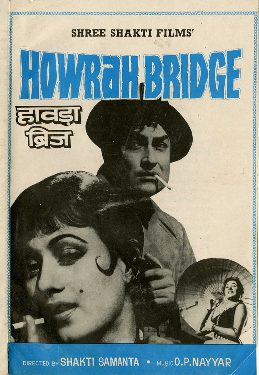
8. Howrah Bridge (1958)
Overview
Prem Kumar (Ashok Kumar) travels from Rangoon to Calcutta to find the killers of his brother Madan (Chaman Puri) and to recover a precious family heirloom.
He meets with dancer Edna (Madhubala) in the ship on his way.
He meets Shyamu (Om Prakash) when he reaches Calcutta. Shyamu is a tangawala who knows Prem’s family. Prem learns from Shyamu that his brother went to a shady hotel the night of his death. They go to the hotel run by Chang (Madan Puri).
Prem encounters Edna once again in that hotel. It turns out that Edna and her uncle Joe (Dhumal) have been smuggling contraband for Chang.
Edna develops feelings for Prem and convinces Shyamu to move Prem into the hotel run by Joe. Prem tries to get close to her so he could learn more about Chang and his nefarious activities.
As Prem’s investigation advances, a dispute breaks out between Chang and Pyarelal leading to Pyarelal killing Chang. He manages to frame Prem for the murder. With Edna’s help, Prem outwits the villains and get them arrested. He recovers his family heirloom and unites with Edna.
Bombay Noir Elements in the Movie
- A businessman (Ashok Kumar) arrives in Calcutta to investigate the murder of his brother Madan (Chaman Puri) and recover a precious family heirloom
- A criminal syndicate consisting of Chang (Madan Puri), Pyarelal (K N Singh) and Joe (Dhumal)
- Femme fatale (Madhubala) who works for the villain who falls in love with the hero
- Night club in Joe’s hotel and a secret den in Chang’s hotel are prominent locales for much of the action
- Organized crime including smuggling and selling stolen property illegally is a significant element of the plot
- Low key lighting and black and white cinematography by Chandu
What I Liked in this Movie
Howrah Bridge is a slick crime drama with distinctly noir elements. Shakti Samant made other movies that can be considered “noir adjacent”, like Inspector, Jaali Note, Singapore and China Town, but Howrah Bridge is the one film that stands out as a noir film.
The moral ambiguity in this case is from the heroine’s perspective. She is initially shown as a willing participant in smuggling. But when she falls in love with the hero, she wants to leave the world of crime.
As the genre evolved through the fifties, the criminal enterprise becomes more sophisticated with secret dens and radio communications. The night club also becomes more upscale.
Artists Who Made the Difference
Howrah Bridge is an interesting Bombay Noir movie. For one thing, the movie is not based in Bombay but Kolkata. Most of the team is new. It is directed by Shakti Samanta. Ashok Kumar, Madhubala and Omprakash are new to the genre. The femme fatale doubles up as the hero’s love interest.
The movie moves at a quick pace and the editing is perfect. Ashok Kumar as the suave businessman and Madhubala as the cabaret dancer are perfectly cast.
The black and white cinematography captures the exotic beauty of the Hooghly River and the Howrah Bridge. The frequent tours of the streets of Calcutta are also charming.
In an interesting touch, real life brothers Chaman Puri and Madan Puri are shown at the beginning in classic noir style where Chaman brings his family heirloom to the fence Madan Puri to sell it to him.
Music and Lyrics
O P Nayyar once again delivers great music.
Castanets and horse hoofs once again make an appearance. But this time it is an actual horsedrawn cart. The songs are “Yeh Kya Kar Daala Tune” and “Eenth ki Duggi Paan Ka Ikka, Kahin Joker Kahin Satta Hai”.
Two cabaret numbers became very popular – “Mera Naam Chin Chin Chu” picturized on Helen and “Aaiye, Meherbaan” picturized on Madhubala. O P Nayyar also composed his trademark street song symbolizing blossoming love between the hero and heroine – “Mohabbat Ka Hath, Jawani Ka Palla, Subhanallah”.
Qamar Jalalabadi and Hasrat Jaipuri make their debut as lyricists for noir movies.
Conclusion
In my view, these eight movies represent the best of this genre as they have a distinct edge centered around crime and its consequences. They were all highly successful commercially, despite flawed characters and lack and glitz and glamor.
A big factor in their success is the rejection of the maudlin sentimentality that dominated the movies of the forties and early fifties. In many ways, these movies were the inspiration for the “angry young man” era of the seventies, which in turn was a rejection of the soppy sentimentality of the sixties.
The other big reason of course is the phenomenal music and songs in these movies. Even the background music is distinctly noir, underscoring the dread and angst of the core theme of these movies.
In conclusion, let me leave you with this thought-provoking statement by the aforementioned Rajeev Shrivastava –
“Bombay noir was never just about crime. It was about the fusion of light and shadow, danger and desire, city grit and lyrical song. It borrowed from Hollywood’s chiaroscuro and femme fatales but grounded them in the smells, sounds, and songs of Bombay — a city where survival was a hustle, and beauty was always tinged with risk.”
What was your favorite Bombay Noir Movie? Tell us in the comments below.


Let us know what you think about this post