“I learned the craft of cinema from Hollywood but used that knowledge to make films that are utterly Indian – in content and essence.” – Satyajit Ray
Folk singer Pete Seeger once said that plagiarism is basic to every culture. Every film industry borrows. Some call it homage, some call it inspiration, some call it “creative adaptation,” and Bollywood — with its swagger, sentiment, and song‑soaked heart — has always had a special talent for taking a Hollywood skeleton and dressing it in full‑blown Hindi melodrama.
Over the years, I watched and loved so many movies that looked authentically Indian, only to discover much later that some scenes, some characters, the plot, or sometimes the entire movie is a direct copy & paste from a Hollywood movie, albeit with the addition of desi masala.
As Pete Seeger said, plagiarism is not unique to Hindi movies. Hollywood is replete with examples of making movies inspired in whole or in part by the classics from around the world, including from Hindi movies. I guess what is good for the goose is good for the gander!
My point is that art by definition is an imitation, and while flagrant violations of copyrights may not be kosher, creative adaptations or generating a new theme by synthesizing components from multiple sources should be acceptable. After all, many ragas in classical music evolved through this very process.
Next time you watch an obscure foreign movie and realize that some scene or a plot element in that movie was the inspiration for your beloved Hindi movie, just remember that “imitation is the sincerest form of flattery”.
This list is a celebration of that curious alchemy: the movies that lifted their plots from Hollywood — sometimes faithfully, sometimes flamboyantly – and crossed oceans, changed accents, added six songs, and somehow became our own.
Anhonee (1952)
Inspired by: A Stolen Life (1946)
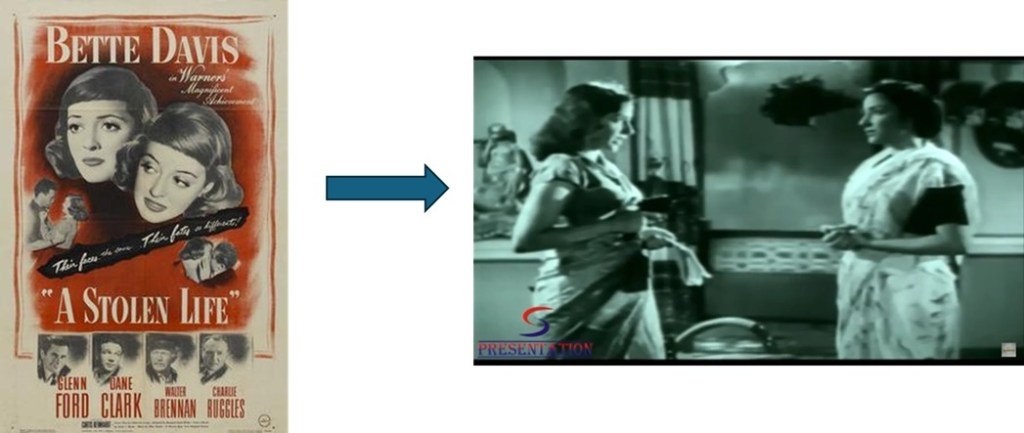
Similarities: Both films revolve around twin sisters — one gentle, one troubled — and the emotional chaos that erupts when identities blur.
Differences: Anhonee shifts the Hollywood psychological drama into a moral‑melodramatic register, adding social stigma, romance, and a more empathetic arc for the “darker” twin, reflecting Indian storytelling’s preference for redemption over punishment.
Nargis acted well as both sisters in the movie. “Main Dil Hun Ek Armaan Bhara” continues to be a popular song today – a rare Talat Mehmood song picturized on Raj Kapoor.
When I saw Anhonee, I would’ve never imagined it to have been inspired by a Hollywood movie. The melodrama and the far-fetched premise of the movie was of course par for the course in Hindi movies of that era. But I thought Hollywood movies were different. I was obviously mistaken. I discovered later that the motif of the evil twin was used in Hollywood as early as 1935 in the Boris Karloff movie “The Black Room”.
Chori Chori (1956) & DIl Hai Ke Manta Nahin (1991)
Inspired by: It Happened One Night (1934)
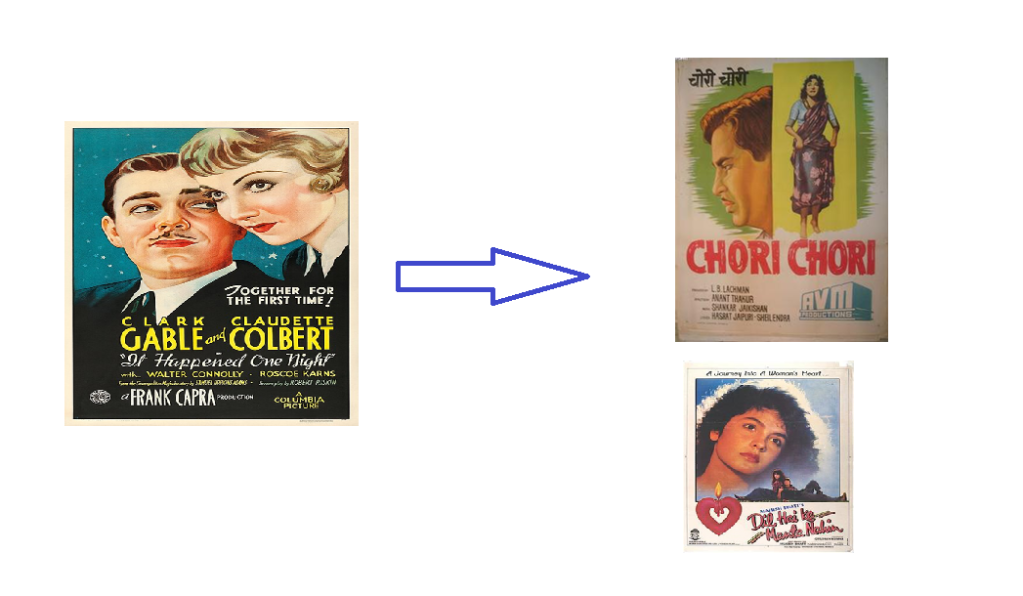
Similarities: A runaway heiress, a cynical journalist, a road trip, and the slow burn of unexpected love.
Differences: Bollywood adds songs, humor, and a gentler emotional palette in both adaptations. The sexual tension of the original becomes a more innocent, flirtatious dynamic, wrapped in Shankar‑Jaikishan’s music and Raj Kapoor–Nargis chemistry in the case of Chori Chori, and Nadeem-Shravan’s music and the Pooja Bhat-Amir Khan chemistry in the care of Dil Hai Ke Manta Nahin.
Raj Kapoor and Nargis were more than a match for the inimitable Clark Gable and Claudette Colbert. Not sure if I’d say the same thing about Aamir Khan and Pooja Bhat.
The narration, acting, comedy and editing for Chori Chori were a treat to watch. Unexpected pleasure for me of discovering the Telugu actress Rajasulochana’s comic skills. Bhagwan dada and Johnny Walker showed their trademark moves in their respective songs. Who would’ve thought that such a delightfully quirky comedy was in fact a “Copy-paste-masala” adaptation of Clark Gable’s equally delightful and equally quirky comedy.
I watched Dil Hai Ke Manta Nahin out of nostalgia for Chori Chori, but frankly I was disappointed. All the elements were there, but the magic was missing. Neither the comedy nor the music came anywhere close to Chori Chori’s standards.
Phir Subah Hogi (1958)
Inspired by Crime and Punishment (1935)
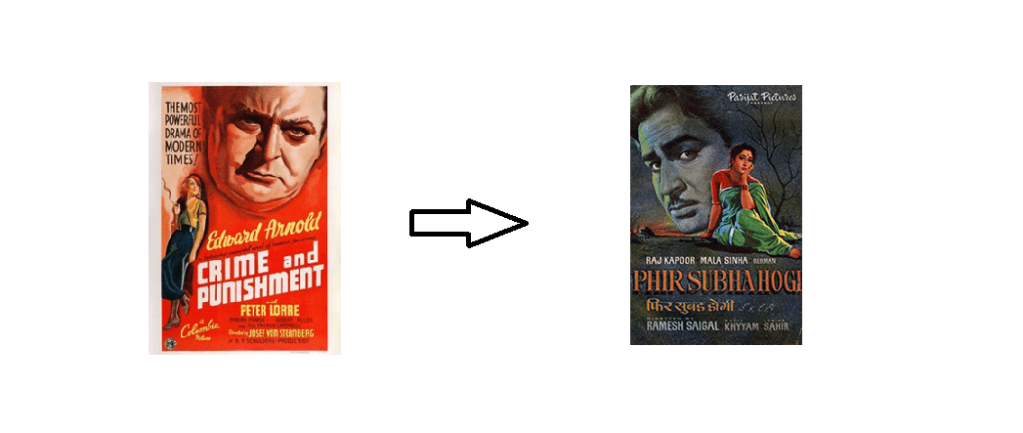
Similarities: Both movies based on Fyodor Dostyovsky’s timeless novel “Crime and Punishment“.
Differences: While the Hollywood version largely stayed true to Dostyovsky’s story, Bollywood took creative liberties with Dostyovsky’s theme of the moral dilemmas facing a criminal and makes the motivations and character traits of the protagonist and the girl he loves more palatable to an Indian audience.
This is the third Raj Kapoor movie in this list, and an unexpected treat. Subdued performance by Raj Kapoor. If I am not mistaken, this is the only movie where he is paired with Mala Sinha. As always, the music and songs make this uniquely Indian, with heartfelt lyrics by Sahir, soulful music by Khayyam, and understated vocals by Mukesh. Apart from the evergreen hit “Woh Subah Kabhi To Aayegi”, I also love Sahir’s tongue-in-cheek parody of Iqbal’s “Saare Jahan Se Achha” – “Cheen-o-arab hamara, hindostan hamara, rahne ko ghar nahin hai, sara jahan hamara!”.
Gumnaam (1965)
Inspired by: And Then There Were None (1945) & Ten Little Indians (1965)
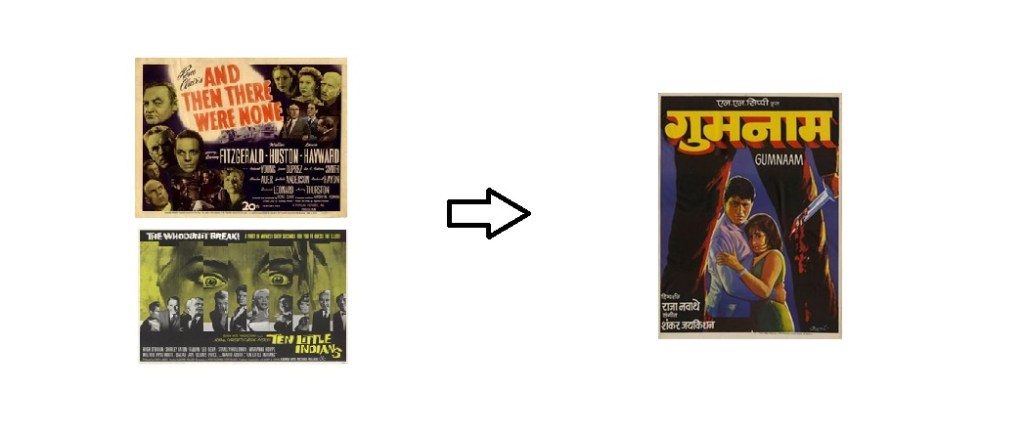
Similarities: All three movies are based on Agatha Christie’s famous novel “And Then There Were None“, with strangers brought to an isolated location under false pretenses, and then each guest getting killed in mysterious circumstances. Each guest has a questionable past and a plausible motive for someone to kill them.
Differences: While the Hollywood versions retained Christie’s basic motif of the nursery rhyme, and had the same original character as the villain, they did differ in a couple of aspects – in Ten Little Indians, there are two survivors. Also, the location is a snow lodge instead of an isolated island. Gumnam on the other hand took quite some liberties with the plot. The motive, the killer, the premise, and ending, are very different from Christie’s novel. There is no nursery rhyme binding the murders together. There are typical Bollywood masala elements like romance, songs, comedy, etc.
There have been more Hindi movies that used all or part of the “strangers lured to an exotic location to be killed” motif – Game (2011) and Neeyat (2023) to name a couple – but I am focusing on Gumnaam for this post.
Manoj Kumar in his pre-“Mr. Bharat” days and minus his famous face palm gives a surprisingly suave performance. Nanda as his love interest has little scope to perform but is probably a good choice for the role of the hapless heiress of a murdered millionaire. Pran and Helen indulge in an unlikely romance in the midst of all the murder and mayhem happening. The music by Shanker Jaikishen and lyrics by Shailendra created some memorable songs, including “Gumnaam Hai Koi”, “Jaan Pehchan Ho”, and “Hum Kaale Hain To Kya Hua Dilwale Hain”.
Majboor (1974)
Inspired by: The Godfather (1970) and Cold Sweat (1970)
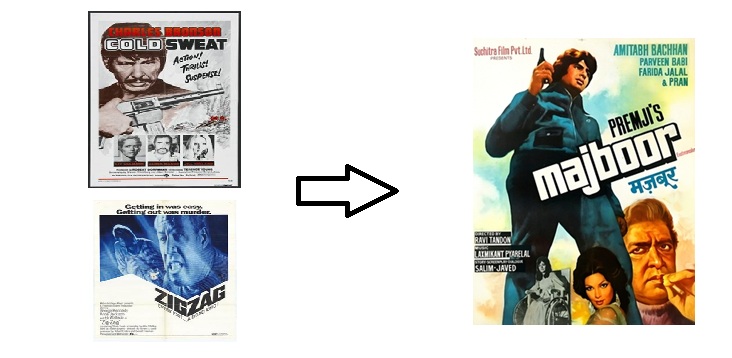
Similarities: Since this is an instance where plot elements and motifs were chosen from each movie and are synthesized into the plotline for Majboor, it is hard to give a simple description of similarities. The main premise of the false confession by a terminally ill patient to get the reward money for the family is taken from the George Kennedy movie “Zig Zag”, while the latter half of Majboor borrows heavily from Charles Bronson’s “Cold Sweat”, including the iconic car race scene where the hero is bringing a doctor in time to get to a mortally wounded person who could clear his name and help him get back to his family.
Differences: The Hindi version of course is uniquely bollywood, with romance, sentiment and songs. The details of the actual crime, and the investigation by the police, etc are unique to Majboor. In Zig Zag, the hero does escape from Prison and investigates the crime as in Majboor, but the Zig Zag version of this plot is much more sombre and methodical, while Majboor vastly expands the premise, adding the larger criminal network and the high-speed car chase from Cold Sweat, Michael (Pran)’s character playing a crucial role in the investigation, and of course the flamboyant Bollywood style confrontation with Satyen Kappu, the villain. In both Zig Zag and Majboor the hero gets exonerated at the end, but in Zig Zag, the mood is more reflective, while Majboor ends with a typical group photo and the assurance that good will always triumph over evil.
It took the genius of Salim Javed to fuse two movies that were on two ends of the emotion – action spectrum and make it into a cohesive story. Amitabh Bachan plays the reticent and gentle middle class man a la George Kennedy in Zig Zag in the beginning, and the fierce vigilante chasing after the criminals to save himself and his family a la Charles Bronson in Cold Sweat in the climax. He effortlessly switches personalities, a typical conceit in Hindi movies.
The fast-paced climax borrows heavily from Cold Sweat, showing the trademark Salim Javed slickness.
Music by Lakshmikant Pyarelal and lyrics by Anand Bakshi are acceptable but do not stand out. The song “Dekh Sakta Hun Main Kuch Bhi Hote Hue, Nahin Main Nahin Dekh Sakta Tujhe Rote Hue” was noteworthy.
This was another movie where I had no idea that it was inspired by not one but two Hollywood movies when I watched it. It was only much later when I watched Cold Sweat on TV that I realized that the car chase sequence was directly taken from that movie.
Dharmatma (1975)
Inspired by: The Godfather (1972)
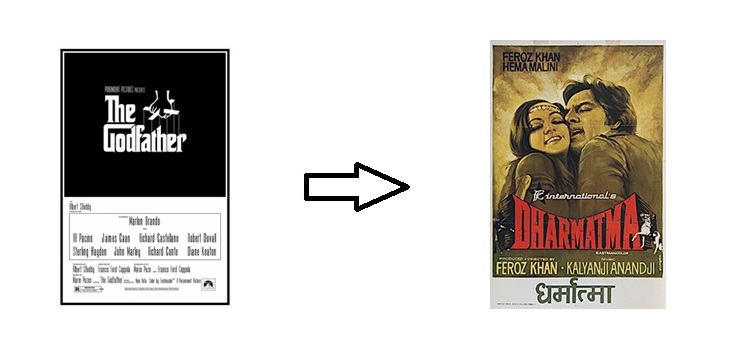
Similarities: The “good” son of a crime family living in exile and returning to the “family business” after an attack on the patriarch, murder of his girlfriend, family politics and betrayals, intrigue involving rival gangs, and the overall ambience of the “benevolent dictator”.
Differences: As in the case of Gumnam, here too the Hollywood movie is more faithful to the plot of Mario Puzo’s novel, while Dharmatma diverges significantly in the plot, with the patriarch getting killed instead of just being wounded, and especially in the final denouement of the protagonist’s motives in rejecting the criminal world, while Michael Corleone embraces it and becomes the new Godfather. There is of course the inevitable Bollywood masala of romance, music and melodrama.
The Godfather. the quintessential gangster film based on Mario Puzo’s novel is considered a cult classic. With stalwarts like Marlon Brando, Al Pacino, James Caan and Diane Keaton, this was destined to be a movie for the ages and held the record for the highest grossing Hollywood movie until The Exorcist surpassed it in 1974.
Academics reference The Godfather to analyze complex socio-political concepts like power consolidation, negotiation strategies, and to a large extent the popular conception of how the mafia operates.
Given the stature of the original, Feroz Khan showed a lot of hubris in adapting this plot for his movie Dharmatma. I am giving this preamble because a straight up comparison will be somewhat misleading and perhaps unfair to Dharmatma.
Premnath, while no match for Marlon Brando’s histrionics, was very credible as the “Dharmatma” who was known as the benefactor of many, while ruling over a criminal gambling empire. Likewise, it would be unfair to compare Feroz with Al Pacino. But as a person who watched the movie without the benefit of either reading the book or seeing the Hollywood version, to me this was a compelling movie with a well-structured story, great cinematography – especially the scenes in Afghanistan.
Good music by R. D. Burman. Indivar’s lyrics were not bad, with the occasional unintended hilarity (“kab tak mein rahoongi man mein – suraj hoga, neel gagan mein jab tak” – this as the sub is setting in the background. Did he mean he is just whiling away his time till the sun sets, and then he’s off to greener pastures?).
Baazigar (1993)
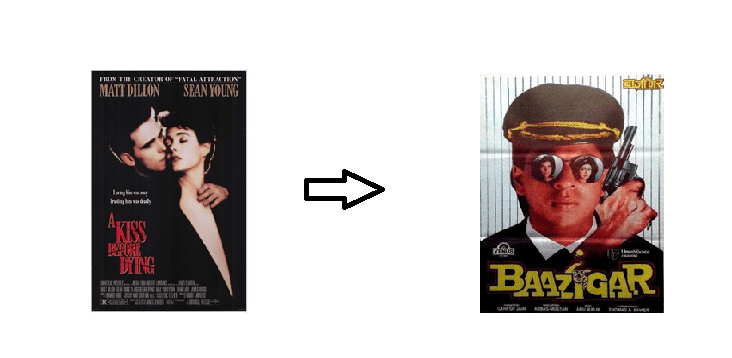
Inspired by: A Kiss Befhttps://en.wikipedia.org/wiki/A_Kiss_Before_Dying_(1991_film)ore Dying (1991)
Similarities: With two significant exceptions, Baazigar adheres closely to the narrative blueprint of A Kiss Before Dying. In both stories, a young man targets a wealthy businessman’s family and begins by courting the elder daughter. After winning her trust, he takes her to what she believes is a civil ceremony for marriage, but instead leads her to a rooftop and pushes her to her death, staging the murder as a suicide. He then assumes a new identity and pursues the younger daughter, simultaneously ingratiating himself with the father and securing a place within the family and its business empire. As the younger sister grows increasingly suspicious about the circumstances of her sibling’s death, she continues to investigate. Each time a clue threatens to expose him, the protagonist eliminates the person who might reveal the truth, even going so far as to murder a childhood friend and frame him posthumously as the killer. Ultimately, the younger sister encounters his mother, uncovers his true identity, and in the ensuing confrontation the protagonist is fatally wounded.
Differences: The differences, though few, fundamentally reshape the moral architecture of the story. In A Kiss Before Dying, the protagonist’s motive is pure sociopathic ambition — a cold pursuit of wealth and social mobility. In Baazigar, however, the killings are rooted in a vigilante‑revenge narrative: the girls’ father had stolen the hero’s family fortune, murdered his father, and driven his mother into suffering. This shift transforms the protagonist from a calculating sociopath into a tragic anti‑hero shaped by trauma. The endings diverge just as sharply. The original concludes with a clinical, almost detached exposure of the killer, emphasizing his unrepentant nature. Baazigar, in contrast, reveals the protagonist’s tragic backstory, moving the heroine to sympathy even as she confronts him. He ends up dying in his arms in a characteristic Hindi movie ending.
SRK’s breakout anti‑hero turn takes a cold American thriller and injects it with Bollywood’s signature emotional voltage. Music by Anu Mallik gave us a couple of catchy tunes – “Yeh Kaali Kaali Aankhen”, and “Aye Mere Humsafar”. Kajol and Shilpa Shetty were the first of many heroines whose career began opposite Shahrukh.
Hum Tum (2004)

Inspired by: When Harry Met Sally (1989)
Similarities: Hum Tum follows the broad emotional and structural blueprint of When Harry Met Sally. Both films center on a man and a woman who meet as strangers, clash immediately, and then encounter each other repeatedly over many years. Each meeting marks a new stage in their emotional evolution, gradually transforming initial irritation into friendship and eventually into love.
In both narratives, the protagonists represent contrasting worldviews: the man is witty, cynical, and emotionally evasive, while the woman is principled, organized, and emotionally articulate. Their long‑term dynamic is built on banter, ideological disagreement, and the slow erosion of emotional defenses.
Both films use time jumps to show how people grow, mature, and soften with age. The relationship develops not through dramatic events but through accumulated moments — conversations, arguments, reconciliations, and shared vulnerabilities. The central thesis in both stories is that friendship is the foundation of lasting love, and that romantic connection often emerges only after years of emotional familiarity.
Differences: When Harry Met Sally is rooted in American urban realism — its humor is dry, its conflicts psychological, and its emotional beats understated. The film examines modern relationships through neurotic banter, gendered debates, and the anxieties of intimacy. Its tone is observational, almost anthropological, and its emotional climax is grounded rather than melodramatic.
Hum Tum, by contrast, reframes the same relationship arc within the grammar of Bollywood romance. The film introduces songs, stylized humor, and heightened emotional beats, including a major narrative divergence: Rhea’s marriage, widowhood, and subsequent rediscovery of companionship. This layer of grief and healing has no equivalent in When Harry Met Sally and gives Hum Tum a distinctly Indian emotional resonance.
The long‑arc friendship‑to‑love journey is reimagined with animated interludes and Kunal Kohli’s glossy urban touch. Saif Ali Khan and Rani Mukherji exhibit the kind of chemistry and subtle comfort in each other’s presence that is the foundation of the friendship-to-love journey. The use of the hero’s comic strip as a metaphor for their relationship is a nice touch. Rani Mukherji showcases her versatility as a fiercely independent woman who can at the same time be vulnerable and let the moment take her where it may.
Music by Jatin Lalit and lyrics by Prasoon Joshi were pleasant, especially the song “Saanson ko Saanson mein dhalne do zara” – reminiscent of “Pyaar Hua Ikraar Hua” from Shri 420 with the couple getting drenched in the rain and visualizing a future in their relationship through the eyes of random people they encounter on the street.
Kaante (2002)
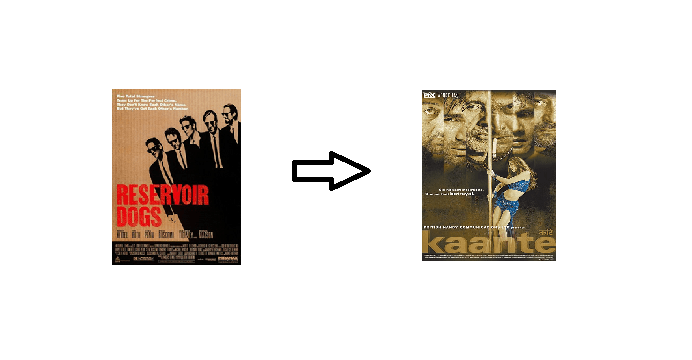
Inspired by: Reservoir Dogs (1992)
Similarities: Both films center on a group of criminals who come together for a high‑stakes heist, only for the job to go catastrophically wrong. The bulk of the story unfolds after the failed robbery, in a single enclosed location where the surviving members turn on one another, convinced that one of them is a police informant.
Differences: Reservoir Dogs is a stripped‑down, minimalist crime thriller — claustrophobic, nihilistic, and almost theatrical in its focus on dialogue, tension, and moral decay. Its characters are defined primarily by their criminal identities, and the film’s ending is brutally abrupt, emphasizing the futility of loyalty in a world governed by violence.
Kaante, by contrast, reframes the same narrative structure within the grammar of Bollywood action‑drama. The characters are given detailed backstories, often involving personal trauma, romantic relationships, or family responsibilities. This humanization shifts the tone from Tarantino’s cold cynicism to a more emotional, character‑driven ensemble drama.
The film also expands the heist itself — which Reservoir Dogs famously never shows — into a full‑fledged action set‑piece, aligning with Bollywood’s emphasis on spectacle. Songs, stylized action, and emotional confrontations add layers of melodrama absent in the original.
A stylish, swaggering ensemble heist that wears its Tarantino influence proudly.
Aitraaz (2004)
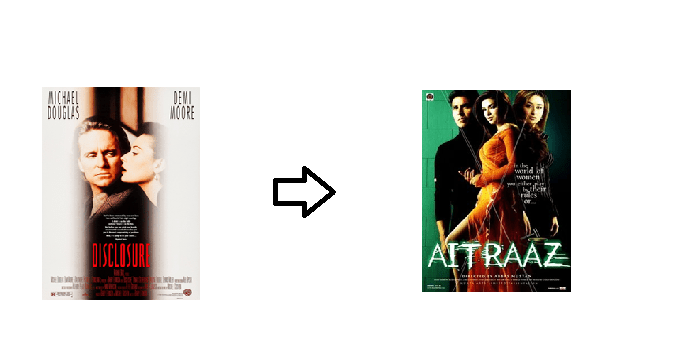
Inspired by: Disclosure (1994)
Similarities: Aitraaz follows the essential narrative architecture of Disclosure. Both films center on a male professional whose career and reputation are jeopardized when a powerful female superior makes an unwanted sexual advance and, upon being rejected, accuses him of harassment. The central dramatic engine in both narratives is the reversal of the expected gender dynamic in workplace harassment cases, using the premise to explore power, credibility, and the weaponization of corporate structures.
In both films, the protagonist is initially blindsided by the accusation and finds himself isolated within a corporate environment that instinctively sides with the accuser due to her seniority and influence. The legal or quasi‑legal proceedings that follow become the narrative’s spine, with the hero forced to defend his integrity, reconstruct the events of the encounter, and expose the truth behind the false allegation.
Differences: Reservoir Dogs is a stripped‑down, minimalist crime thriller — claustrophobic, nihilistic, and almost theatrical in its focus on dialogue, tension, and moral decay. Its characters are defined primarily by their criminal identities, and the film’s ending is brutally abrupt, emphasizing the futility of loyalty in a world governed by violence.
Kaante, by contrast, reframes the same narrative structure within the grammar of Bollywood action‑drama. The characters are given detailed backstories, often involving personal trauma, romantic relationships, or family responsibilities. This humanization shifts the tone from Tarantino’s cold cynicism to a more emotional, character‑driven ensemble drama.Disclosure is a corporate techno‑thriller rooted in the anxieties of 1990s American workplace culture — mergers, digital infrastructure, and the politics of male‑female power dynamics in a rapidly evolving corporate environment. Its tone is sleek, procedural, and grounded in legal‑corporate realism. The protagonist’s struggle is professional and reputational, and the film’s resolution is clinical, emphasizing institutional accountability and the exposure of corporate corruption.
Aitraaz, by contrast, reframes the same conflict within the grammar of Bollywood melodrama and moral storytelling. The protagonist’s backstory is expanded to include a romantic history with the antagonist, adding emotional complexity absent in Disclosure. The female antagonist’s motivations are also reinterpreted: while Disclosure presents her as an ambitious executive driven by power and sexual aggression, Aitraaz situates her actions within a broader arc of insecurity, vanity, and moral corruption, aligning with Bollywood’s tradition of heightened emotional stakes.
The legal proceedings in Aitraaz are more dramatic and theatrical, incorporating moral arguments, emotional appeals, and character testimony rather than the procedural corporate logic of Disclosure. The film also introduces a supportive wife who becomes central to the hero’s defense — a dynamic not present in Disclosure, where the protagonist’s marriage is strained by suspicion and mistrust.
Finally, the endings diverge sharply. Disclosure concludes with a professional vindication that is precise and unemotional, consistent with its corporate‑thriller tone. Aitraaz ends with a more moralistic resolution: the antagonist faces social and personal downfall, the hero’s marriage is reaffirmed, and justice is framed not merely as institutional but as ethical and emotional restoration.
In essence, Aitraaz retains the structural skeleton of Disclosure but transforms it into a Bollywood‑inflected moral drama, expanding emotional motivations, adding relational depth, and reframing the conflict within a culturally specific discourse on marriage, morality, and redemption.
A gender‑flipped corporate thriller that gave Priyanka Chopra one of her earliest standout roles.
Conclusion
Bollywood’s relationship with Hollywood isn’t just imitation — it’s translation. These films show how stories travel, how they mutate, how they find new emotional registers in new cultures. A thriller becomes a melodrama. A rom‑com becomes a musical. A heist becomes a morality play. And somewhere in that transformation, something uniquely Indian emerges.

Your feedback helps us improve the blog. Please leave a Reply